CLiME is committed to studying the role of law and policy in encouraging or inhibiting opportunity based on place. Its non-partisan efforts are designed to promote more equitable approaches to public law and policy amid rapid demographic change, shrinking government resources and enduring racial and economic divides. Where possible, CLiME’s efforts recognize the interdependent relationship among places in a given region and the most inclusive conceptions of sustainability.
CLiME proceeds from this premise: Communities are the product not only of their residents but of their legal rules and institutional networks. Stable communities are characterized by such resources as a strong tax base, the democratic participation of members, solid schools, robust civic organizations, steady economic growth and healthy opportunities for recreation, self-expression and meeting basic household needs for goods and services. These are hallmarks of middle-class residential organization. Unstable communities experience the opposite—declining tax bases, weakened social and political structures, overwhelmed public institutions and severe underinvestment. These are traits associated with poor or economically marginalized areas.
The study of metropolitan equity reveals the structural inequality that often exists among communities and municipalities within the very same region and the inequitable processes that sustain inequality. Sustained inequality is inefficient, unfair and violative of important legal norms. Persistent patterns of racial and economic segregation brought about through exclusion, flawed public policy and discrimination exacerbate inter-local disparities in ways that threaten the prospects for opportunity across entire metropolitan areas, making them less competitive, more expensive and, for those in greatest need, unnecessarily difficult. The importance of developing more inclusive laws and policies of mutuality increases amid the growing racial and ethnic diversity of metropolitan America. Few states reflect these trends more than New Jersey. Through CLiME’s research, archives, public forums and collaboration with others, the center's fellows and faculty staff are committed to promoting both statewide and national discourse on the many subjects they collectively refer to as “metropolitan equity and equitable growth.”
David Dante Trouttis Distinguished Professor of Law and Derrick A. Bell Scholar. David Troutt is the founding director of the Rutgers Center on Law in Metropolitan Equity (CLiME). He teaches and writes in four areas of primary interest: the metropolitan dimensions of race, class and legal structure; intellectual property; Torts; and critical legal theory. His major publications (noted below) include books of fiction and non-fiction, scholarly articles and a variety of legal and political commentary on race, law and equality.
Rewriting Racial Equality: The State of Civil Rights Law under Trump documents the second Trump administration’s blueprint for radically transforming how the federal government views and enforces civil rights. The new legal order taking shape upends Reconstruction-era understandings of equal protection and related federal statutes while recasting the modern Civil Rights Movement as a defense against anti-white race discrimination.
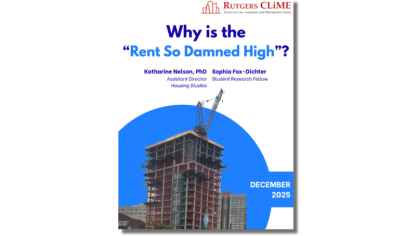
Why is The “Rent So Damned High”? explores the drivers of high and rising rents and proposes a series of policies to address rental unaffordability in New Jersey and respond to changes at the federal level. Most experts say the chief explanation for high rents is an undersupply of housing and push a “build, build, build” strategy to bring rents down. Through a deep dive of academic and public research, we identified the primary drivers of high and rising rents.
Diverging Dynamics: The 2023 Displacement Risk Indicators Matrix (D.R.I.M.) Update for Newark explores how the risk of displacement in Newark has changed since 2010. Newark is experiencing the steady erosion of affordability as rents rise faster than incomes. In this latest installment of CLiME’s displacement analysis, diverging patterns of urban change are becoming clearer across wards with uneven but unmistakable signs of gentrification.